The updated list has been published by Interbrand (the people who brought you the slogan “a Mars a day helps you work, rest and play”) and they describe it as the ‘definitive ranking of the world’s most valuable brands’.
There are several activities to think about before you actually start looking at the list.
Firstly, set yourself the quick challenge of trying to anticipate which brands you’ll see in the Top 10 or Top 20. Next, try to think who is on the way up and who has had a difficult year. The league table helpfully compares the ranking this year with last.
http://www.interbrand.com/en/knowledge/best-global-brands/best-global-brands-2008/best-global-brands-2010.aspx
The last question is the most interesting. How would you compile a league table like this? What factors might you rake into account? Helpfully, here's how 'Interbrand' did it:-
http://www.interbrand.com/en/best-global-brands/best-global-brands-methodology/Overview.aspx
Friday, 17 September 2010


Tuesday, 14 September 2010
A2 Unit 3: Outsourcing & Offshoring...
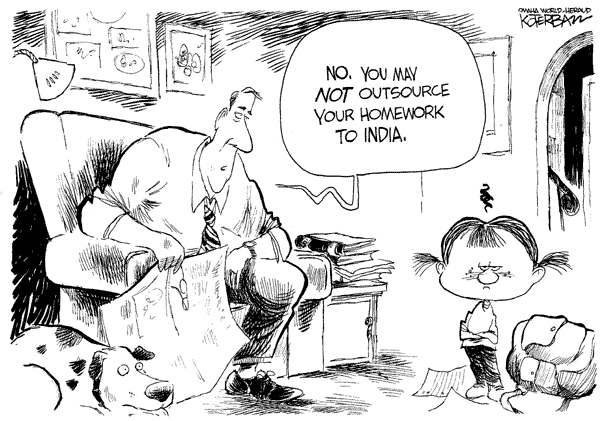
An interesting and topical example of outsourcing here, which should get teachers and students into a lively discussion during lessons on operations…
Outsourcing as a strategy has been around for a long time, but it is not associated with the UK education system as closely as it is with, say, financial services and other customer-service operations.
This primary school is outsourcing the teaching / tutoring of maths support to a team of tutors in India.
http://www.telegraph.co.uk/education/educationnews/7992178/School-outsources-teaching-to-India.html
Sounds like the service costs around £3-4k for the support provided, which is a good deal less costly than having a specialist maths tutor physically in the classroom. Is it a good idea? Might we see more of this as schools find their budgets tightening further? How does the school ensure that students are getting the right quality of tutoring?
Students often get confused with the difference between outsourcing and offshoring. The use of India-based tutors above is an example of both.
Outsourcing involves the use of a third party (supplier) to provide services rather than have people employed within the business/organisation to do them. So outsourcing can occur both in the UK (domestically) and overseas.
Offshoring involves the provision of services from a differerent country. That might be by a firm’s own employees, or by a supplier/contractor.
Outsourcing as a strategy has been around for a long time, but it is not associated with the UK education system as closely as it is with, say, financial services and other customer-service operations.
This primary school is outsourcing the teaching / tutoring of maths support to a team of tutors in India.
http://www.telegraph.co.uk/education/educationnews/7992178/School-outsources-teaching-to-India.html
Sounds like the service costs around £3-4k for the support provided, which is a good deal less costly than having a specialist maths tutor physically in the classroom. Is it a good idea? Might we see more of this as schools find their budgets tightening further? How does the school ensure that students are getting the right quality of tutoring?
Students often get confused with the difference between outsourcing and offshoring. The use of India-based tutors above is an example of both.
Outsourcing involves the use of a third party (supplier) to provide services rather than have people employed within the business/organisation to do them. So outsourcing can occur both in the UK (domestically) and overseas.
Offshoring involves the provision of services from a differerent country. That might be by a firm’s own employees, or by a supplier/contractor.
Monday, 6 September 2010
Year 11 Business Studies: Dragons Den Exercise (Part 1)
Part 1
You are about to watch a clip from ‘The Dragons Den’. Whilst you are watching the clip I want you to try and answer the following questions.
This is not a test, some of the questions will be open ended and based on your opinions.
What is the company name?
Give a brief synopsis of the business?
What was the valuation the directors placed on the company?
Do you think they have a 'unique selling point' (USP)?
What is the estimated market size? (ie number of potential customers)
What is their estimated market value?
How many customers do they have at present?
How many restaurants are on board and what % of London does this make?
What would they do with the money?
Would you invest?
Part 2
You are about to watch a clip from ‘The Dragons Den’. Whilst you are watching the clip I want you to try and answer the following questions.
This is not a test, some of the questions will be open ended and based on your opinions.
What is the company name?
Give a brief synopsis of the business?
What was the valuation the directors placed on the company?
Do you think they have a 'unique selling point' (USP)?
What is the estimated market size? (ie number of potential customers)
What is their estimated market value?
How many customers do they have at present?
How many restaurants are on board and what % of London does this make?
What would they do with the money?
Would you invest?
Part 2
What was the turnover figure for the last financial year?
What are the turnover projections, expenses and net profit estimates for years 1 - 3?
Would you invest?
Would you invest now?
Now work in pairs: I want you to discuss what was good about this model, what was bad about the model and the reason why you as a pair decded to invest or not in the business?
Part 3
You are now going to split into 4 groups. I want you to discuss and come up with a potential business idea. Eventually you will present to myself, Mrs McCormack and Miss Meeajan. (The Dubai Dragons)
In the presentation, you will have a valuation of the company, an estmated sales projection and profit figure for 3 years.
This will be a competition. You will be presenting to the Dubai dragons, but your peers will also comment on the positives and negatives of your pitch.
NB During the pitch you will be expected to dress appropriately...you decide!
Mr Bentley
Monday, 31 May 2010
IGCSE Revision Site (Year 11)
I have added another revision site onto the blog. It appears on the right hand side as 'IGCSE Revision Site'
I have also included the link below:
http://www.dineshbakshi.com/igcse-gcse-business-studies.html
I have also included the link below:
http://www.dineshbakshi.com/igcse-gcse-business-studies.html
Wednesday, 31 March 2010
IGCSE Business Studies - holiday work
 Please visit the following site and download as many past papers and mark schemes as you require;
If you require a 'Secure download', the username is my e mail address;
and the password is;
fa1thful (thats a 1 not an i)
NB Revision skill a) look at the question, b) revise the relevant topics, c) attempt the past paper under timed conditiond and d) check your answers with the mark schemes.
Good luck, see you all after the break.
Wednesday, 24 March 2010
Quality control - the old fashioned way!!

I am sure you have seen the 'Quality Control'clip at the Nissan factory....well here is a similar car manaufacture doing it slightly differently!!
Subscribe to:
Posts (Atom)